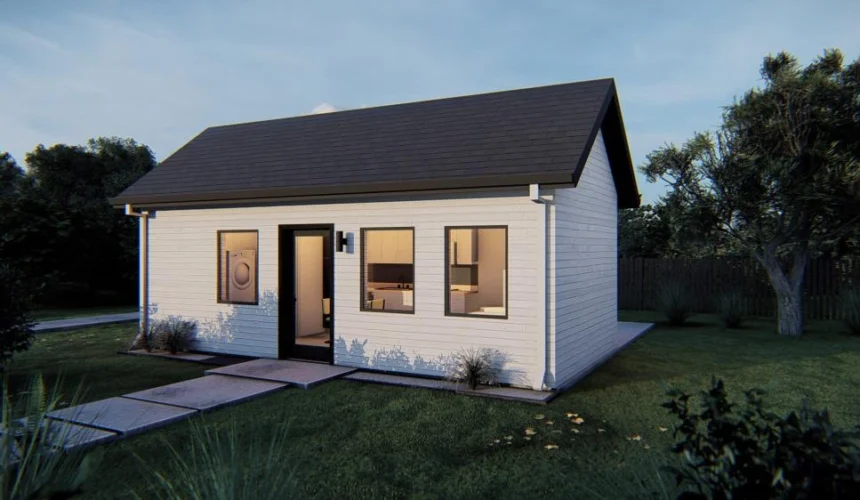
Dave Potter explains that in Massachusetts an ADU is an additional dwelling on the same lot, while a tiny home can be a standalone house but often functions as a detached ADU. A “protected” ADU is capped at 900 square feet or half the main home, whichever is less. Tiny homes are not cheaper per square foot because kitchens, baths, foundations, and utilities do not scale down. Codes require egress, insulation, and energy ratings, and off grid or trailer living is generally restricted. For detached units, some towns require separate water and sewer. Careful measuring and planning help maximize what you can build.
John Maher: Hi, I am John Maher and I’m here today with Dave Potter. Dave has been a licensed builder and real estate developer since 1980, and he’s completed hundreds of projects in his career. Now Dave is specializing in accessory dwelling units or ADU in Massachusetts. Today we’re talking about tiny homes versus ADUs. Which one is right for you? Welcome, Dave.
Dave Potter: Good to be here, John.
Differences Between ADU and a Tiny Home
Maher: Yeah, thanks. Dave, what’s the core difference between a tiny home and an accessory dwelling unit or ADU?
Potter: Well, they’re both considered ADS here in Massachusetts, so as long as they’re on the same lot as the existing structure. Tiny homes that came from a house, a separate house, of being a thousand square foot or so or less, and there are actually developments, not so much in Massachusetts, but like North Carolina and other places that actually have these tiny homes. They’re tiny, 900-1000 square foot, but they’re their own house on their own lot.
Maher: So that’s the main house structure as opposed to being an additional house on a property with an existing home.
Potter: So, now some people are putting it in, is allowed by law. You can do it, put a separate structure on the same lot as the existing structure, and that turns out to be, it can only be 900 square foot, can’t be any bigger than that to be in a protected ADU, what they call a protected ADU in Massachusetts, and which means you have to right to build it. As of right.
You can just go out and take on a building permit and start building it. You may have to go to a site plan review type of process, but usually those are quick. But the tiny home is its own structure and it’s just like building another house except it’s smaller. And you would think that the price per square foot would be less because it’s tiny, right? It’s actually more, there’s still a bathroom involved.
There’s still a kitchen involved. There’s still a foundation involved. Still excavation is still a water and sewer going all the way out to the street involved. There’s still another electrical service coming in all involved. It’s just like building another house, except if you can build a house for say, $300 a square foot, that would be more like three 50 a square foot because it’s less space to amortize the kitchen and the bathroom and everything over that less space.
Zoning Laws for Tiny Homes and ADUs
Maher: Right. Do zoning rules differ between tiny homes and ADUs?
Potter: The building code is a building code. It’s got to be a certain amount of egress, be a certain egress in there. The windows has to be a certain size. The headroom has to be, the height has to be a certain size. You have to have so many different clearances and different things like that. So all of those there and still has to be. Any new construction has to be a certain in installation, it has to go. It has to be going through a HERS rating, which is energy rating. All of that has to be done in new construction. If you’re doing an addition, you may not have to do all of that, but you still have to have a certain amount of installation by code. You still have to have a relatively efficient heating system and air conditioner going in and all that other stuff, and there is some money back from some of these utilities to do that stuff, and there is an incentive to do that.
Tiny Homes and Off-Grid Living
Maher: Are tiny homes probably better for off grid uses or even, I know some people put tiny homes even on a trailer and they use it as like a camper or something like that, or is that sort of more the place where tiny homes come into play?
Potter: We don’t see that that much in Massachusetts. As a matter of fact, there are some codes and laws and regulations that have nothing to do with the building code, but you can’t really live in a trailer in yard. You’ll see sometimes in a TV show or a movie, somebody’s living in a trailer in their yard. That’s not really going to fly so much in Massachusetts because you have neighbors, they’re going to complain and you really can’t do that. And to put a tiny home on a trailer, I don’t see that often.
Potter: However, I did see tiny homes on a boat before and they lived on the boat until the storm came along and wiped the boat out. But I see that sometimes.
Rules for Building a Tiny Home
Maher: Now, are there rules against even building a tiny home on a piece of property? Are there minimum requirements for square footage? In some towns,
Potter: There’s no minimum requirement. There is maximum. You can be a maximum. You’re going to think of the concept of the existing dwelling. In the existing dwelling. You can only build onto it or build another home or build another structure in the lot up to half of whatever the existing structure is, up to 900 square feet, whichever is less.
So, if the existing structure is 1500 square feet, you can only build 750 square foot, another structure or an addition or whatever there, and there’s always little ways to bend around there. They measure if you really want to push the envelope, you can legally, they measure the existing structure square footage from the inside of the wall. Some people say, well, my house is 24 by 32, yes, but inside it’s 22 by 30. So, that’s how they measure it. But they also include the basement even if it’s not finished because it has a certain head height. They include that.
So, if you have 600 square foot basement that can be included in your calculations. So now all of a sudden you sit there and say, well, I have 1200 square foot of house. I can only build a 600 square foot. Whoa, whoa, whoa. You have a basement, you have an 1800 square foot house. Now you can build a 900 square foot ADU, and that’s where hiring a professional, somebody that’s an expert at ADUs comes in and helps you get your a DU of your dreams built.
Structural Differences Between a Tiny Home and an ADU
Maher: Right. Would there be structural differences between what we would call a tiny home and what we call in ADU?
Potter: No. Well, the structural difference would only be to have four walls. Instead of having, say, three walls, say you would build in an addition, you’d have three walls. One of the walls would be in the existing house, but you still have to have span rating and insulation rating and certain things. The windows have to be a certain U rating, which is just the inverse of an R rating. So you still have a lot of those same considerations. It’s just that on another ADU, that’s a separate building on the same lot would be more to it because now you have to build a foundation, four walls, you have to dig it out. You have to make sure you’re within the setbacks and all of that.
Maher: All right. Well, that’s really great information, Dave. Thanks again for speaking with me today.
Potter: Thank you, John.
Maher: Yeah. For more information about Dave and ADU projects in Massachusetts, you can visit davepotteradu.com or call six six build ADU. That’s 662-845-3238.